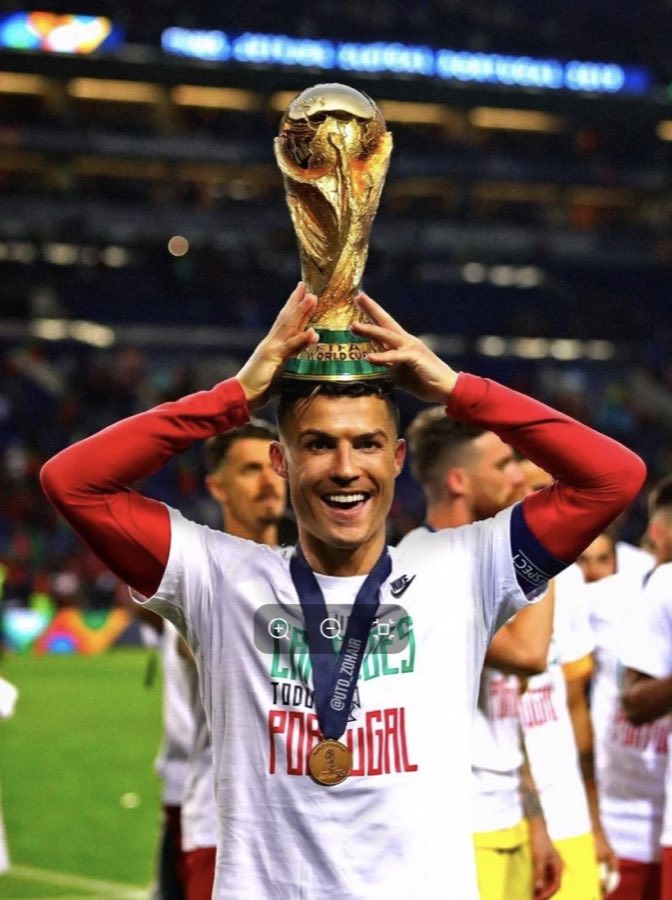
Cristiano Ronaldo is set for one more World Cup, and even after everything he has done, that sentence still carries weight.
At 41, Ronaldo is preparing for the 2026 FIFA World Cup with Portugal, a tournament expected to be his final appearance on football’s biggest stage. If he plays, he will become the first male footballer to feature in six different World Cups. For a player whose career has been built on records, obsession and refusal, Cristiano Ronaldo 6th World Cup 2026 feels less like a statistic and more like a closing scene.
This is not just another campaign. It is Ronaldo last World Cup 2026. The final walkout. The final anthem. The final chance to chase the one trophy that has always stayed just out of reach.
Portugal will arrive with a stronger squad than many casual fans realise, and Ronaldo will arrive with the eyes of the sport on him again. Some will watch to see if he can still bend a tournament to his will. Others will watch because they know this is the end of an era.
Either way, Cristiano Ronaldo final World Cup is going to be one of the emotional threads of 2026.
From teenage winger to football monument
Ronaldo’s World Cup story began in 2006, when he was still more winger than striker, more electricity than control. Portugal reached the semi-finals in Germany, and a young Ronaldo looked like part of the next great wave.
Then came the long, complicated years.
In 2010, Portugal were difficult to beat but short on imagination. In 2014, Ronaldo was carrying physical issues and a team that never really looked settled. By 2018, he produced one of the great individual World Cup nights: that hat-trick against Spain in Sochi, sealed by a free-kick that felt almost scripted. It was pure Ronaldo theatre. Chest out. Pressure rising. Finish delivered.
The 2022 World Cup in Qatar was different. It was messier. Ronaldo scored against Ghana, becoming the first male player to score in five different World Cups, but by the knockout rounds he was no longer untouchable. He started on the bench against Switzerland. Portugal looked quicker without him. Then came the quarter-final defeat to Morocco, and the image of Ronaldo walking down the tunnel in tears.
That moment felt like an ending.
It wasn’t.
Now comes the sixth chapter, and it is not the same Ronaldo chasing the same story. His pace is different. His role is different. His relationship with the team is different. But the hunger? That part still seems familiar.
Portugal have changed around him
The biggest difference between Ronaldo’s early World Cups and this one is the team around him.
Portugal are no longer built simply around his gravity. They have elite players across the pitch: Rúben Dias as a defensive leader, Diogo Costa in goal, Nuno Mendes flying from left-back, Vitinha controlling rhythm, Bruno Fernandes creating and scoring, Bernardo Silva finding pockets of space, Rafael Leão stretching games wide.
That changes the C Ronaldo 2026 World Cup role.
He does not need to be the entire attack anymore. In fact, Portugal may be at their best when he is one piece of a more flexible front line rather than the single fixed point. The debate will be whether he starts every major match, starts selectively, or becomes a high-impact veteran who can still decide games inside the box.
That debate will not be quiet.
The Portugal World Cup squad 2026 picture is fascinating because it mixes one of the greatest players ever with a generation that grew up watching him. The younger players respect him, but they also play a different kind of football: quicker combinations, more rotations, more pressing triggers, less waiting for one superstar to solve everything.
For a wider look at where Portugal sit among the field, the 2026 World Cup teams page is the natural starting point.
Ronaldo’s task is to fit into that version of Portugal without losing the edge that made him Ronaldo in the first place.
Will he start?
That is the question Roberto Martínez cannot avoid.
Ronaldo still offers things few players can. His penalty-box movement remains elite. He attacks space before defenders sense it. He can still turn an average cross into a shot. He still carries intimidation, especially against teams that defend deep and panic when the ball hangs in the air.
But tournament football is cruel to sentiment.
Portugal cannot pick him because of the past. They have to pick him because the match asks for him. Against a low block, Ronaldo may still be the best penalty-area weapon in the squad. Against a fast, pressing opponent, Portugal may need more mobility around the first line.
The smartest version of his role may be flexible: start some games, manage minutes in others, and stay fresh enough for the moments that matter.
The World Cup 2026 schedule will influence that heavily. Rest days, travel, kickoff times and opponent style will all shape how Portugal use a 41-year-old forward across a long expanded tournament.
If managed well, Ronaldo does not need to dominate every minute. He needs to dominate the right ones.
The debate will follow him everywhere
Ronaldo has never travelled quietly through a tournament.
There will be those who say Portugal are better when they move on. They will point to age, pressing, defensive work, and the need for the attack to breathe without always bending toward him. Some of that criticism will be fair. Some of it will be lazy. All of it will be loud.
Then there will be the fans who simply want one last look.
They remember the 2018 free-kick against Spain. They remember the Ghana goal in 2022. They remember the Champions League nights, the European Championship win, the impossible longevity. For them, this is not just a selection question. It is a farewell tour with stakes.
Ronaldo’s condition will matter. His minutes at club level, sharpness in qualifying, movement between matches and recovery after travel will all be watched closely. At 41, preparation becomes part of the story. Every sprint is evidence. Every quiet game becomes a debate. Every goal becomes proof that the old fire is still there.
That is the strange power of Ronaldo now. Even when he is not the whole game, he is still the headline inside it.
The records still matter
Ronaldo has always chased records openly. He does not pretend otherwise. That is part of the appeal and part of the tension.
The Ronaldo World Cup goals record 2026 conversation needs some honesty. Catching Miroslav Klose’s all-time World Cup record of 16 goals is almost certainly too far away. Ronaldo has eight World Cup goals. Asking him to double that at 41 would be fantasy, not analysis.
But other records are alive.
He can extend his mark as the only male player to score in five World Cups if he scores in a sixth. He can push closer to Eusébio’s Portuguese World Cup scoring record. He can become one of the oldest scorers in tournament history. And, if Portugal go deep, he can finally add the missing chapter to a career that already feels overloaded with medals.
That is why the World Cup 2026 predictions around Portugal will be so interesting. They are not favourites purely because of Ronaldo. They are contenders because the squad is deep, balanced and technically strong. Ronaldo is the emotional accelerator, not the only engine.
Still, imagine the noise if he scores in a knockout match.
For all the tactical arguments, football still makes room for those moments.
Can Portugal win it?
Yes, but not because of nostalgia.
Portugal have enough quality to compete with anyone. The midfield is clever. The defence has leaders. The wide players can hurt teams in transition. The goalkeeper is reliable. The squad has tournament experience and enough younger legs to survive the expanded format.
The question is whether they can find the right balance between respect for Ronaldo and freedom from Ronaldo.
If every attack becomes a search for No. 7, Portugal may become predictable. If Ronaldo is used with clarity, surrounded by runners and creators who do not defer too much, he can still be dangerous.
That balance may decide their ceiling.
Portugal’s route will also matter. The tournament schedule could hand them a manageable rhythm or a brutal travel pattern. In a 48-team World Cup, logistics are not background noise. They are part of performance.
Ronaldo knows this better than anyone. World Cups are not won by talent alone. They are survived by timing, health, calm and finishing.
One last World Cup story
There is something unusually human about this final chapter.
Ronaldo has spent most of his career looking almost engineered for greatness: the body, the repetition, the certainty, the numbers. But the 2026 World Cup will show him in a different light. Older. Still proud. Still dangerous. But closer to the end than the beginning.
That is why this will grip people far beyond Portugal.
Some fans want a fairytale. Some want closure. Some want to see whether time finally wins. Others just want to say they watched Cristiano Ronaldo at a World Cup one last time.
Whatever happens, the story is already enormous.
Cristiano Ronaldo 6th World Cup 2026 is not just another record chase. It is the final tournament chapter of one of football’s defining careers. Maybe Portugal go deep. Maybe Ronaldo scores again. Maybe the ending is painful, because World Cups often are.
But when he walks out in 2026, the sport will pause for a second.
Because everyone will know what they are watching.
Not just another match. Not just another superstar.
The last World Cup journey of Cristiano Ronaldo.