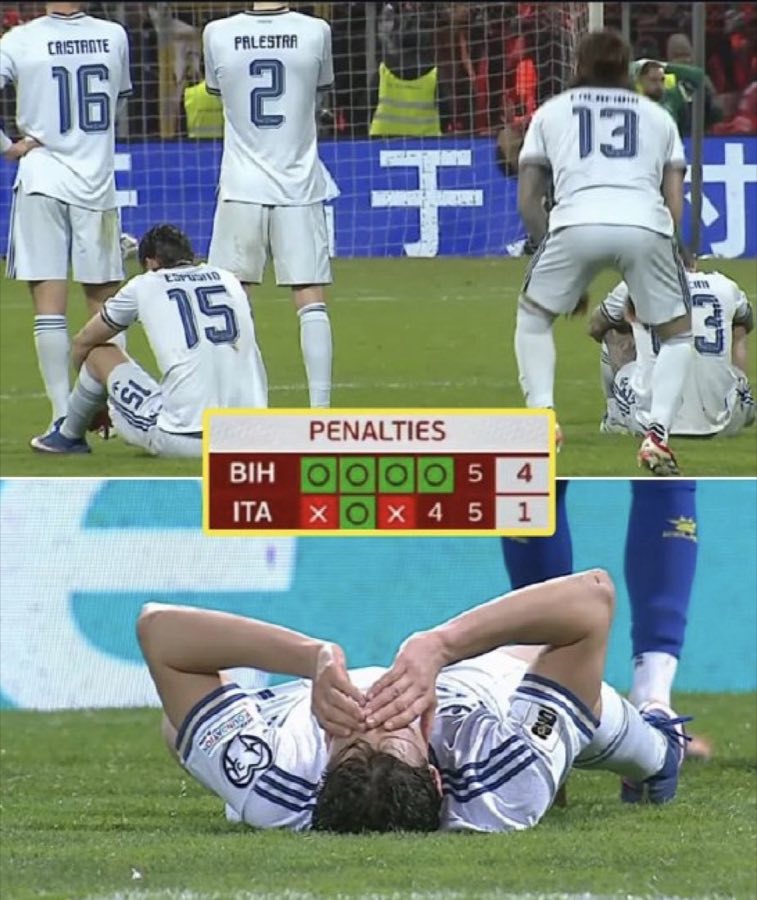
Another World Cup without Italy
Italy are out of the 2026 World Cup, and somehow the sentence still feels unreal.
This is Italy we are talking about. Four-time world champions. The country of Cannavaro, Pirlo, Buffon, Baggio, Maldini, Rossi and Totti. A nation that once seemed almost genetically wired for tournament football.
And yet, for the third World Cup in a row, the Azzurri will be watching from home. Italy missed World Cup 2026 after another bruising qualifying campaign, and the absence leaves a huge emotional hole in the complete tournament field.
For younger fans, this is becoming a strange kind of normal. Italy have not played at a men’s World Cup since 2014. That is not a bad cycle anymore. That is a lost era.
The question now is not just “Will Italy play in 2026 World Cup?” We know the answer: no. The harder question is why a country with this much football culture, this much pressure, and this much history keeps finding new ways to fall short.
What happened in qualifying
Italy World Cup qualifying results 2026 tell a story of warning signs ignored until it was too late.
The campaign never really felt settled. There were decent spells, individual flashes, and nights when Italy looked close to finding rhythm. But qualifying is not built on almost. It is built on clean wins, ruthless finishing, and the ability to manage pressure when the table starts tightening.
That is where Italy fell short. They dropped control in key moments, failed to turn pressure into enough goals, and allowed decisive matches to become nervous, open, dangerous affairs. The Azzurri did not collapse in one single scene. They chipped away at their own margin for error until there was none left.
By the time the final qualifying picture came into focus, Italy were stuck in the same uncomfortable place they have known too well: needing rescue through late results, playoff pressure, and emotional survival football.
The wider World Cup 2026 schedule will now move forward without Italy fixtures to circle, without the anthem under North American floodlights, and without one of football’s great tournament identities in the group stage.
Why Italy failed to qualify for 2026 World Cup
There is no single explanation, which makes the failure worse.
Tactically, Italy looked caught between identities. They were not the old defensive machine that could suffer for 70 minutes and still win 1-0. They were not a modern pressing side with clean attacking patterns either. Too often, they had possession without threat, structure without speed, and pressure without a killer finish.
That is dangerous football. Especially when the team defending a narrow lead no longer has the certainty Italy once had.
The squad also carried imbalance. There is talent, of course. Gianluigi Donnarumma remains a top goalkeeper. Alessandro Bastoni is one of Europe’s strongest defenders. Sandro Tonali gives the midfield bite and range. But Italy lacked the ruthless forward line that changes qualification nights.
They lacked a settled attacking hierarchy. They lacked wide players who could repeatedly beat a man and tilt a match. And when legs got heavy, the bench did not always feel like a rescue plan compared with other 2026 World Cup teams built around clearer attacking roles.
Injuries and availability issues did not help, but they cannot be the whole excuse. Every national team deals with them. The deeper issue is that Italy’s margin for error had become too thin. One missed chance, one nervous spell, one late lapse, and the whole structure wobbled.
That is how you get an Italy World Cup disaster 2026: not one ridiculous mistake, but a long chain of small cracks finally giving way.
The missed chances hurt most
The cruel part is that Italy had chances to avoid all of this.
They had enough possession in important games. They had enough experience in the squad. They had enough moments where one cleaner final ball or one calmer finish could have changed the mood of the entire campaign.
But qualifying is not about reputation. It is about handling the ugly parts of matches. Italy too often played like a team aware of the history sitting on its shoulders. You could feel the memory of 2018. You could feel the memory of 2022. Once games tightened, the shirt looked heavier.
That psychological weight matters. It is not an excuse, but it is real. It will also change how people approach World Cup 2026 predictions, because one of the traditional tournament wild cards is missing completely.
How this compares to 2022
The 2022 failure was supposed to be the one that forced change.
Italy had just won Euro 2020. They were European champions, unbeaten in long stretches, and still managed to miss Qatar after losing to North Macedonia. That defeat felt absurd because it came so soon after triumph. It was a footballing contradiction.
The 2026 failure feels different.
This one is less shocking as a one-off and more frightening as a pattern. Italy not in World Cup 2026 means three consecutive misses: 2018, 2022, 2026. At some point, bad luck stops being the headline.
The 2022 absence was humiliation. The 2026 absence is evidence. It shows that Italian football has not solved the gap between club success and national-team reliability, even as the tournament schedule keeps expanding and offering more routes into the finals.
Serie A can still produce tactical sophistication. Italian clubs can still compete in Europe. Italian coaches are everywhere. But the national team has not built a stable attacking identity or a qualification machine strong enough to survive bad nights.
That is the part that should scare the federation most.
What it means for Italian football
The impact goes beyond one summer.
A third straight World Cup without Italy damages the national team’s connection with a generation of fans. There are teenagers in Italy who have never properly watched the Azzurri at a men’s World Cup. That is almost unthinkable for a country where the tournament used to be part of football’s emotional calendar.
Commercially, culturally, emotionally, it hurts.
Players lose the biggest stage. Young fans lose the memories that turn national teams into lifelong attachments. The federation loses credibility. Coaches inherit not just a squad, but a wound.
It also affects the 2026 World Cup itself. Italy bring weight. They bring tension. They bring travelling supporters, defensive drama, penalties, arguments, history. Without them, the tournament loses one of its great football languages.
For the field itself, Italy’s absence opens space. Another European side gets the spotlight. Another story moves up the bracket. The Azzurri fail to qualify for 2026, and the list of qualified nations suddenly feels more open in some ways, but also less complete.
What comes next for Italy
The next step has to be honest.
Not dramatic speeches. Not another promise that “Italy will return stronger.” Italian football has heard that before. What it needs now is a colder review of how the national team identifies players, builds attacks, handles qualifying pressure, and prepares for knockout-style moments.
There has to be a clearer attacking plan. There has to be a pathway for forwards who actually score. There has to be less dependence on reputation and more accountability for performances.
The Azzurri also need to reconnect with their public. Fans can forgive defeat. They struggle to forgive drift. And right now, Italy feel like a team drifting between what they used to be and what they have not yet become.
The next European Championship cycle will matter. The next Nations League matches will matter. Every squad list will be examined through the same painful lens: is this finally the group that stops the decline?
Because Italy out of 2026 World Cup is not just a headline. It is a warning.
A great football nation does not disappear overnight. It fades through repeated failures that everyone explains until explanations stop working.
Italy have reached that point now. The next chapter has to be more than recovery. It has to be reinvention.
Italy out of 2026 World Cup is not just a headline. It is a warning.